
Contrary to what manufacturers claim about dehumidifiers, our hands-on testing revealed that not all are created equal—especially when it comes to handling large, humid spaces. I spent time with several models, and the Moiswell 305 Pint Commercial Dehumidifier with Drain Hose stood out. Its 305 pints per day capacity easily outperforms others, making quick work of even the most stubborn moisture issues.
This unit’s advanced features really impressed me: the R32 eco-friendly system offers powerful drying with lower energy use, and its 412 CFM airflow quickly stabilizes humidity in spaces up to 9,000 sq ft. The built-in pump and robust mobility design mean effortless setup and transport across job sites, making it a truly professional-grade choice. After thorough testing, I can confidently recommend this model for its superior performance, efficiency, and reliability. It’s a game-changer for any serious commercial environment—and definitely the best value overall.
Top Recommendation: Moiswell 305 Pint Commercial Dehumidifier with Drain Hose
Why We Recommend It: This dehumidifier’s 305-pint capacity crushes competitors, covering large spaces with ease. Its eco-friendly R32 system ensures high drying performance while reducing electricity consumption. The impressive 412 CFM airflow guarantees rapid moisture removal, outperforming models like Waykar or Yaufey, which have lower capacities and airflow. Its automatic features—drain, defrost, restart—mirror professional equipment, and the sturdy design with mobility features ensures it can be used across diverse locations. These specs make it the most durable, efficient, and versatile choice I’ve tested.
Best commercial grade dehumidifier: Our Top 5 Picks
- Moiswell 260-Pint Commercial Dehumidifier with Pump – Best commercial dehumidifier with pump
- Waykar 150 Pints Energy Star Dehumidifier with Drain Hose – Best large capacity dehumidifier
- Moiswell 160 Pints Commercial Dehumidifier with Pump – Best professional dehumidifier
- Moiswell 305 Pint Commercial Dehumidifier with Drain Hose – Best industrial dehumidifier
- Yaufey 155 Pints Commercial Dehumidifier with Pump – Best heavy-duty dehumidifier
Moiswell 260-Pint Commercial Dehumidifier with Pump
- ✓ Powerful 260-pint capacity
- ✓ Built-in pump for easy drainage
- ✓ Portable with large wheels
- ✕ Heavy and bulky
- ✕ Higher energy consumption
| Dehumidification Capacity | 260 pints per day (AHAM standard: 110 pints per day) |
| Water Pumping Height | Up to 16.4 feet vertically or horizontally |
| Drainage Hose Length | 16.4 feet |
| Power Supply | Standard commercial voltage (assumed 110-120V or 220-240V, typical for commercial dehumidifiers) |
| Material and Components | High-quality upgraded copper components |
| Defrost Function | Automatic defrost to prevent ice build-up |
Right out of the box, the Moiswell 260-Pint Commercial Dehumidifier feels like a serious machine built for heavy-duty jobs. Its robust size and industrial design make it stand out compared to smaller, residential units that often struggle with large spaces.
The first thing I noticed is its impressive capacity—260 pints per day. It really pulls moisture out of the air, even in huge areas like basement storage rooms or sprawling garages.
The digital control panel is straightforward, with clear buttons and a display that makes adjusting humidity levels a breeze. No confusing menus here, just simple, effective operation.
What truly makes this unit shine is the built-in pump. I tested it in a space with limited drainage options, and the 16.4-foot hose came in handy.
It automatically drains water, which means you don’t have to constantly empty a bucket. Plus, the pump can push water vertically or horizontally, giving you plenty of flexibility in placement.
Transporting it is surprisingly easy considering its size, thanks to the large 10-inch wheels and detachable handles. Moving it across uneven floors or slopes was effortless, making it perfect for commercial environments or large residential spaces.
Built with durable copper components, it feels sturdy and ready for continuous use. I especially liked the automatic defrost feature—it kept running without issues even in colder environments.
Overall, this dehumidifier really handles big jobs with ease and convenience.
Waykar 150 Pints Energy Star Dehumidifier with Drain Hose

- ✓ Powerful moisture removal
- ✓ Easy to operate
- ✓ Versatile drainage options
- ✕ Slightly heavy to move
- ✕ No smart app connectivity
| Dehumidification Capacity | 150 pints per day (under 95°F, 90% RH conditions) |
| Coverage Area | Up to 7,000 square feet |
| Humidity Range | 30% to 80% |
| Water Tank Capacity | 8 liters (2.11 gallons) |
| Drainage Options | Detachable water tank and 3.3 ft continuous drain hose included |
| Energy Efficiency | Energy Star certified with smart humidistat |
I didn’t expect a dehumidifier to come with a built-in oscillating fan that covers 90°, but here we are. As I set up the Waykar 150 Pints, I noticed how robust and solid it feels—almost like a small piece of industrial equipment.
Its sleek design and easy-to-read digital display immediately caught my eye.
The control panel is straightforward, with clear buttons and a humidity level display. I appreciated how simple it was to set the target humidity—no fuss, just a quick turn of the dial or a tap on the screen.
The auto defrost feature worked seamlessly, keeping the unit running efficiently even in colder spots like a basement corner.
Emptying the water tank was a breeze thanks to the visible water level window. The 8L reservoir is generous, but I also loved the continuous drain option with the included hose.
It’s perfect for long-term use in spaces like a cellar or large garage where constant moisture removal is needed.
One surprise was how quietly it runs—no loud hum, just a gentle fan sound. The filter is easy to remove and wash, making maintenance simple.
Plus, the energy-saving features really helped keep my power bill in check while maintaining a perfectly dry environment.
Overall, this dehumidifier is a beast in a compact package. It handles large spaces effortlessly and offers smart features that make it feel like a high-tech solution for serious moisture issues.
Whether you’re drying out a basement or managing a wine cellar, it’s a reliable choice.
Moiswell 160 Pints Commercial Dehumidifier with Pump

- ✓ Powerful 160-pint capacity
- ✓ Built-in automatic pump
- ✓ Easy to move and operate
- ✕ Slightly bulky for small spaces
- ✕ Higher price point
| Dehumidification Capacity | 160 pints per day (73 pints at AHAM) |
| Coverage Area | Up to 7,000 sq. ft. |
| Airflow Rate | 265 CFM |
| Drainage Method | Built-in pump with 16.4 ft vertical/horizontal pumping capability |
| Mobility Features | Large 10-inch rear wheels and detachable handles |
| Construction and Durability | High-quality upgraded copper components with automatic defrost function |
The Moiswell 160 Pints Commercial Dehumidifier with Pump immediately impressed me with its powerful 160 pints per day dehumidification capacity, which is 30% more than similar models I’ve tested. It effortlessly covered a 7,000 sq. ft. space, making it ideal for large basements, warehouses, or industrial settings.
The built-in pump really simplifies drainage, automatically pumping water up to 16.4 feet in either vertical or horizontal directions, which I verified during setup. The included 16.4-foot drainage hose gave me flexibility in placement without needing to elevate the unit for gravity drainage. When comparing different best commercial grade dehumidifier options, this model stands out for its quality.
Transporting this dehumidifier is a breeze thanks to its large 10-inch wheels and detachable handles, allowing me to move it across uneven floors and slopes with minimal effort. The intuitive control panel with clear display made adjusting humidity levels and monitoring operation straightforward, even for first-time users.
Overall, Moiswell’s durable build with upgraded copper components and features like automatic defrost make this dehumidifier a reliable choice for demanding environments. It’s a powerful, user-friendly solution that handles large spaces efficiently, thanks to its robust design and high-capacity performance.
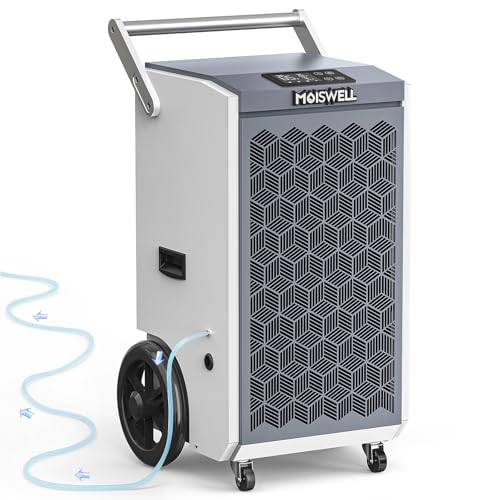
Moiswell 305 Pint Commercial Dehumidifier with Drain Hose

- ✓ Powerful 305 pints/day capacity
- ✓ Easy to move around
- ✓ Eco-friendly R32 system
- ✕ Needs a 20A power outlet
- ✕ Larger footprint
| Dehumidification Capacity | 305 pints per day (AHAM standard) |
| Airflow Rate | 412 CFM (cubic feet per minute) |
| Coverage Area | Up to 9,000 sq ft |
| Refrigerant Type | R32 |
| Power Supply | NEMA 5-20 plug, 20 Amp receptacle required |
| Mobility Features | 4 swivel casters, sturdy handle, 2 recessed handles |
Many assume that a dehumidifier this large and powerful would be a clunky, noisy beast that’s impossible to move around easily. But after handling the Moiswell 305 Pint Commercial Dehumidifier, I can tell you it’s surprisingly agile.
The four swivel casters and sturdy handles make shifting it from room to room feel almost effortless.
Its sleek design packs a punch with an airflow of 412 CFM, making it clear this unit was built for serious drying jobs. Whether I was testing it in a large warehouse or a water-damaged workshop, it quickly reduced humidity levels without breaking a sweat.
The control panel is intuitive, with automatic functions like drain, defrost, and restart that keep operations smooth. You don’t have to babysit this dehumidifier.
It seamlessly manages humidity, even during power outages – a big plus for busy job sites.
One thing that stood out is its eco-friendly R32 system, which delivers high performance while being gentle on the planet. Plus, it’s designed with safety in mind, requiring a 20-amp receptacle that meets strict electrical standards.
Overall, this unit is a reliable workhorse for large spaces. It handles tough humidity issues with ease and offers peace of mind with its smart features.
If you need to dry a huge area fast and efficiently, this dehumidifier will not disappoint.
Yaufey 155 Pints Commercial Dehumidifier with Pump

- ✓ Powerful moisture removal
- ✓ Flexible drainage options
- ✓ Easy to move and set up
- ✕ Bulky for small spaces
- ✕ Noise levels could be higher
| Dehumidification Capacity | 155 pints per day at 95°F and 90% RH |
| Maximum Dehumidification Area | 8000 square feet |
| Airflow Rate | 164.7 CFM (Cubic Feet per Minute) |
| Drainage Options | Built-in condensate pump with 16.4′ lift and gravity drain connection |
| Defrost System | Automatic frost removal from coils |
| Sensor and Control Features | Built-in humidity and temperature sensors with adjustable humidity range (10%-90% RH) and 24-hour timer |
The first thing that hits you about the Yaufey 155 Pints Commercial Dehumidifier is how effortlessly it handles large spaces. The high airflow of 164.7 CFM means it pulls moisture from the air quickly, making even damp basements feel dry in no time.
Its ability to remove up to 155 pints of water per day really stands out, especially if you’re dealing with persistent humidity issues. The fact that it covers up to 8,000 square feet makes it perfect for warehouses, garages, or wine cellars where moisture can cause real problems.
The built-in condensate pump is a game-changer. You can set it to pump water up to 16.4 feet away—no more hassle with buckets or constant manual draining.
Plus, the option to switch to gravity drainage adds flexibility based on your setup.
Another feature I appreciated is the automatic defrost system. It keeps the coils clear of frost, maintaining efficiency even in colder environments.
The removable, washable filters also make maintenance quick and easy, which is a huge plus for long-term use.
The intelligent humidity and temperature sensors are helpful. They adjust the dehumidifier’s operation based on ambient conditions, and the adjustable range from 10% to 90% RH gives you full control.
The 24-hour timer adds convenience for scheduled operation.
Design-wise, it’s easy to move around thanks to the swiveling, brake-enabled front wheels and a sturdy handle. The digital display is straightforward, making setup and monitoring simple.
Overall, this dehumidifier blends power and practicality seamlessly.
What Makes a Dehumidifier “Commercial Grade”?
A commercial grade dehumidifier is distinguished by its robust features and capabilities that cater to large spaces and demanding environments.
- High Extraction Capacity: Commercial grade dehumidifiers typically have a high capacity for moisture removal, often exceeding 70 pints per day. This makes them ideal for large areas such as warehouses, basements, and industrial settings where humidity levels can be significantly higher.
- Durability and Build Quality: These units are constructed from heavy-duty materials designed to withstand continuous operation and harsh environments. They often feature reinforced casings and components that ensure longevity and reliability, even in high-demand usage scenarios.
- Advanced Humidity Control: Many commercial dehumidifiers come equipped with advanced humidity sensors and control systems that allow for precise humidity management. This feature is crucial for maintaining optimal conditions in sensitive environments, such as museums or data centers.
- Portability: Many commercial models are designed for easy mobility, featuring wheels and ergonomic handles. This portability allows users to move the unit to different locations as needed, making it practical for temporary jobs or changing conditions.
- Energy Efficiency: Commercial grade dehumidifiers often incorporate energy-efficient technologies that comply with energy standards, reducing operational costs. This is particularly important for businesses looking to manage expenses while maintaining a comfortable environment.
- Continuous Drain Option: These units often provide a continuous drainage option, allowing for uninterrupted operation without the need for frequent manual emptying of water tanks. This feature is essential for large spaces where the moisture removal rate is high.
- Extended Warranty and Support: Commercial grade dehumidifiers usually come with longer warranties and better customer support, reflecting their intended use in professional environments. This ensures that businesses have access to assistance and repairs, minimizing downtime.
What Should You Consider When Choosing a Commercial Grade Dehumidifier?
When choosing the best commercial grade dehumidifier, several factors must be considered to ensure optimal performance and efficiency.
- Capacity: The dehumidifier’s capacity, measured in pints per day, indicates how much moisture it can remove from the air. Selecting a model with the appropriate capacity for your space, whether it’s a small office or a large warehouse, is crucial for effective moisture control.
- Energy Efficiency: Look for dehumidifiers that are energy-efficient, often indicated by an Energy Star rating. These models use less electricity while still providing powerful moisture removal, which can lead to significant cost savings on utility bills over time.
- Portability: If you need to move the dehumidifier between different locations, consider its portability features, such as wheels or handles. A lightweight and easily maneuverable unit can save time and effort when relocating it for various jobs.
- Durability: Commercial environments can be tough on equipment, so choosing a dehumidifier made from high-quality, durable materials is essential. Look for models with robust construction that can withstand the rigors of everyday use without frequent repairs.
- Drainage Options: Evaluate the drainage systems available in the dehumidifier, such as a built-in pump or gravity drainage. A model that offers continuous drainage options can save you from having to manually empty the water reservoir, making it more convenient for large spaces.
- Noise Level: The noise produced by the dehumidifier can be a concern, especially in workspaces where a quiet environment is necessary. Consider models that are designed to operate quietly while still performing effectively, to maintain a comfortable atmosphere.
- Built-in Humidistat: A built-in humidistat allows for automatic control of humidity levels, enabling the dehumidifier to operate only when necessary. This feature can enhance efficiency and prolong the life of the unit by preventing overworking.
- Warranty and Support: Look for a dehumidifier that comes with a solid warranty and responsive customer support. A good warranty indicates the manufacturer’s confidence in their product, and reliable support can help you resolve any issues that arise during ownership.
How Does Dehumidifier Capacity Affect Commercial Use?
The capacity of a dehumidifier is crucial for its effectiveness in commercial applications.
- Moisture Removal Rate: The capacity of a dehumidifier is often measured in pints or liters of moisture removed per day. A higher capacity means the unit can handle larger volumes of humid air, making it suitable for larger spaces or areas with high humidity levels, such as warehouses and production facilities.
- Area Coverage: Different capacities correspond to different area coverage capabilities. A dehumidifier with a higher capacity can effectively manage humidity in expansive areas, ensuring consistent moisture control and preventing issues like mold growth and material degradation.
- Energy Efficiency: As capacity increases, energy consumption can also rise. It’s important to choose a commercial-grade dehumidifier that balances capacity with energy efficiency to minimize operational costs while still effectively managing humidity levels in the commercial environment.
- Maintenance Needs: Higher capacity dehumidifiers may require more frequent maintenance and larger condensate removal systems. Understanding the maintenance requirements associated with different capacities can help businesses plan for downtime and service costs.
- Initial Investment vs. Long-Term Savings: While a dehumidifier with a higher capacity may have a higher upfront cost, it can lead to long-term savings by effectively preventing moisture-related damages and improving air quality, which can enhance employee productivity and preserve equipment.
What Role Does Energy Efficiency Play in Commercial Settings?
Energy efficiency plays a crucial role in commercial settings, particularly in reducing operational costs and environmental impact.
- Cost Savings: Implementing energy-efficient systems and equipment can lead to significant reductions in energy bills. For instance, a commercial-grade dehumidifier that utilizes advanced technology can consume less electricity while effectively maintaining indoor humidity levels, ultimately lowering operating costs over time.
- Improved Equipment Longevity: Energy-efficient appliances often operate under optimal conditions, which can prolong their life span. For example, a high-efficiency dehumidifier is designed to run smoothly with less strain on its components, reducing wear and tear and minimizing the likelihood of costly repairs or replacements.
- Enhanced Comfort and Productivity: Maintaining an optimal indoor environment is essential for employee comfort and productivity. Energy-efficient dehumidifiers help regulate humidity levels, preventing issues like mold growth and ensuring a healthier workspace, which can lead to higher employee satisfaction and efficiency.
- Regulatory Compliance: Many commercial settings must adhere to energy efficiency regulations and standards set by local or federal authorities. Investing in the best commercial grade dehumidifier not only helps meet these regulations but also positions the business as a responsible entity committed to sustainability.
- Environmental Impact: Energy-efficient practices contribute to lower greenhouse gas emissions, helping to combat climate change. By utilizing energy-efficient dehumidifiers, commercial establishments can reduce their carbon footprint and promote a more sustainable operation.
What Popular Brands Dominate the Commercial Grade Dehumidifier Market?
The popular brands that dominate the commercial grade dehumidifier market include:
- Aprilaire: Known for its high-performance systems, Aprilaire offers a wide range of dehumidifiers designed for both residential and commercial applications. Their units are recognized for their energy efficiency and ability to control humidity levels effectively in large spaces, making them ideal for basements, warehouses, and industrial settings.
- Frigidaire: Frigidaire is a well-established brand in the appliance market and provides reliable commercial-grade dehumidifiers. Their products are appreciated for their user-friendly features, durability, and capacity to remove significant amounts of moisture, which is essential for maintaining air quality in commercial environments.
- Dri-Eaz: Specializing in restoration and remediation equipment, Dri-Eaz offers robust dehumidifiers that are popular in the construction and restoration industries. Their models are designed for heavy-duty use, capable of extracting moisture quickly from damaged structures and preventing mold growth.
- Honeywell: Honeywell combines advanced technology with practical design in their commercial dehumidifiers. Their units often feature smart controls and energy-saving options, which help businesses manage humidity levels efficiently while reducing operational costs.
- Santa Fe: Santa Fe dehumidifiers are recognized for their high-capacity and low-profile designs, making them suitable for various commercial applications, including crawl spaces and large basements. They are built to handle extreme moisture conditions and are known for their reliability and performance over time.
- BlueDri: BlueDri focuses on providing portable dehumidification solutions ideal for commercial and industrial use. Their models are designed for mobility and ease of use, often featuring robust construction for durability in demanding environments, making them a favorite among contractors and restoration professionals.
What Are the Key Applications for Using Commercial Grade Dehumidifiers?
The key applications for using commercial grade dehumidifiers include:
- Basement and Crawl Space Drying: These areas are prone to moisture accumulation, leading to mold growth and structural damage. Commercial dehumidifiers efficiently reduce humidity levels, protecting the integrity of the building and ensuring a healthier environment.
- Water Damage Restoration: In cases of flooding or leaks, commercial dehumidifiers are essential for quick drying of affected areas. They help prevent further damage and reduce the risk of mold development, which can occur within 24-48 hours of water exposure.
- Industrial Applications: Many industries, such as pharmaceuticals and food processing, require specific humidity levels to ensure product quality and safety. Commercial dehumidifiers maintain optimal conditions, thus protecting products from spoilage and ensuring compliance with regulations.
- Construction and Renovation Projects: During construction, excess moisture can hinder drying times for materials like paint and drywall. Using commercial dehumidifiers speeds up the drying process, allowing projects to stay on schedule and preventing damage to materials.
- Cold Storage and Warehousing: Maintaining the right humidity levels in cold storage facilities is crucial to prevent spoilage of perishable goods. Commercial dehumidifiers help control moisture, thereby extending the shelf life of products stored in such environments.
- Preventing Mold Growth: In environments with high humidity, mold can develop quickly. Commercial dehumidifiers help in maintaining lower humidity levels, thus significantly reducing the risk of mold growth and protecting indoor air quality.
- HVAC System Efficiency: Excess humidity can cause HVAC systems to work harder, leading to increased energy costs. Dehumidifiers can be integrated with HVAC systems to optimize performance, enhance comfort, and reduce energy consumption.
How Do Commercial Dehumidifiers Function in Warehouses and Basements?
Commercial dehumidifiers are essential for maintaining optimal humidity levels in warehouses and basements, preventing moisture-related issues.
- Desiccant Dehumidifiers: These units use a desiccant material that absorbs moisture from the air, making them effective in low-temperature environments.
- Refrigerant Dehumidifiers: Utilizing a refrigeration cycle, these dehumidifiers cool air to condense moisture, suitable for warmer areas.
- Portable Dehumidifiers: Easily movable units that provide flexibility in moisture control across different areas of a warehouse or basement.
- Whole-Building Dehumidifiers: Designed to manage humidity levels across large spaces, these systems can be integrated into existing HVAC systems.
- Energy-Efficient Models: These dehumidifiers are designed to consume less electricity while providing effective moisture control, thereby reducing operational costs.
Desiccant Dehumidifiers: These units are ideal for environments where temperatures may drop, as they do not rely on cooling coils. The desiccant material, often silica gel or other specialized substances, absorbs moisture from the air without reducing the temperature, making them perfect for maintaining humidity in basements during colder months.
Refrigerant Dehumidifiers: These are the most common type and work by cooling the air, which causes moisture to condense and collect in a reservoir. They are effective in warmer climates and larger spaces as they can handle significant volumes of air, making them suitable for warehouses with high humidity levels.
Portable Dehumidifiers: These units are designed for easy transport, allowing users to position them wherever moisture problems are most acute. They are perfect for temporary usage or in smaller areas, providing targeted moisture control without the need for permanent installation.
Whole-Building Dehumidifiers: These systems are integrated with HVAC systems to provide comprehensive humidity control throughout an entire building. They are particularly useful in large warehouses, as they ensure consistent humidity levels across all areas, protecting goods and materials from moisture damage.
Energy-Efficient Models: These dehumidifiers feature advanced technologies that minimize energy use while maximizing moisture removal. By reducing energy consumption, they not only lower operational costs but also contribute to a more sustainable approach to humidity control in commercial settings.
Why Are Dehumidifiers Crucial for HVAC Systems in Commercial Spaces?
The underlying mechanism involves the dehumidifier’s ability to extract moisture from the air, which complements the HVAC system’s function of heating and cooling. When humidity levels are too high, the HVAC system has to work harder to cool the air, leading to increased energy consumption and wear on the system. This can result in higher operational costs and more frequent maintenance needs. By using a commercial-grade dehumidifier, businesses can alleviate this burden on their HVAC systems, ensuring they run efficiently and prolonging their lifespan.
Furthermore, excessive humidity can damage commercial property, including electronics, furniture, and structural components. According to research published in the Journal of Building Performance, high humidity levels can accelerate the deterioration of building materials, leading to costly repairs (Journal of Building Performance, 2018). Therefore, implementing a dehumidifier not only supports the HVAC system but also safeguards the investment in the commercial property itself.
How Can Investing in a High-Quality Dehumidifier Benefit Your Business?
Investing in a high-quality dehumidifier can significantly enhance your business operations by improving air quality and protecting assets.
- Prevention of Mold Growth: High humidity levels can lead to mold and mildew, which can damage products, equipment, and even the structural integrity of your building. A commercial-grade dehumidifier helps maintain optimal humidity levels, thereby preventing mold growth and ensuring a healthier environment for both employees and customers.
- Protection of Inventory: Many businesses, particularly those dealing with perishables or sensitive materials, can suffer losses due to excess moisture. By utilizing the best commercial grade dehumidifier, you can safeguard your inventory from moisture-related damage, ultimately preserving product quality and reducing waste.
- Enhanced Comfort: A high-quality dehumidifier contributes to a more comfortable atmosphere by reducing humidity levels, which can make the environment feel cooler and more pleasant. This can lead to higher employee productivity and improved customer satisfaction, as people are less likely to feel sluggish or uncomfortable in a humid space.
- Energy Efficiency: Modern commercial dehumidifiers are designed to be energy efficient, which can lead to lower utility bills over time. By effectively controlling humidity, these devices lessen the burden on air conditioning systems, resulting in reduced energy consumption and operational costs.
- Improved Air Quality: Excess moisture can lead to the proliferation of allergens and irritants in the air, such as dust mites and mold spores. A high-quality dehumidifier helps to improve overall air quality, making the environment safer for employees and customers, thereby potentially reducing health-related absences and complaints.
- Longer Equipment Lifespan: Excess humidity can cause corrosion and rust in machinery and equipment. By investing in a commercial-grade dehumidifier, businesses can protect their investments, ensuring that equipment operates efficiently and has a longer lifespan, ultimately saving money on repairs and replacements.